CalBEM Project Proposal Process
Introduction & Context
CalBEM is an initiative supporting the many facets of building energy modeling (BEM) in California. This group is supported by the California IOUs and hosted by Southern California Edison. Every autumn participants from across the state gather to brainstorm projects in support of CalBEM goals and then meet in smaller Working Groups throughout the year to push these projects forward. Each group focuses on a subset of building energy modeling (BEM) topics.
Participants in CalBEM’s three Working Groups work to identify and prioritize projects that could change building energy modeling in California for the better. With funding, these projects could accomplish larger and longer-term goals. This document outlines a rolling funding proposal application and review process, providing instructions and guidance for project teams seeking project funding and describing the proposal assessment process driven by the CalBEM Steering Committee.
All proposal process materials may be found on the CalBEM Collaborative Sharepoint here. If you are not able to view this link, please request access by emailing info@calbem.com.
Submission Process
Individuals or teams can complete the following steps to be considered for funding through CalBEM:
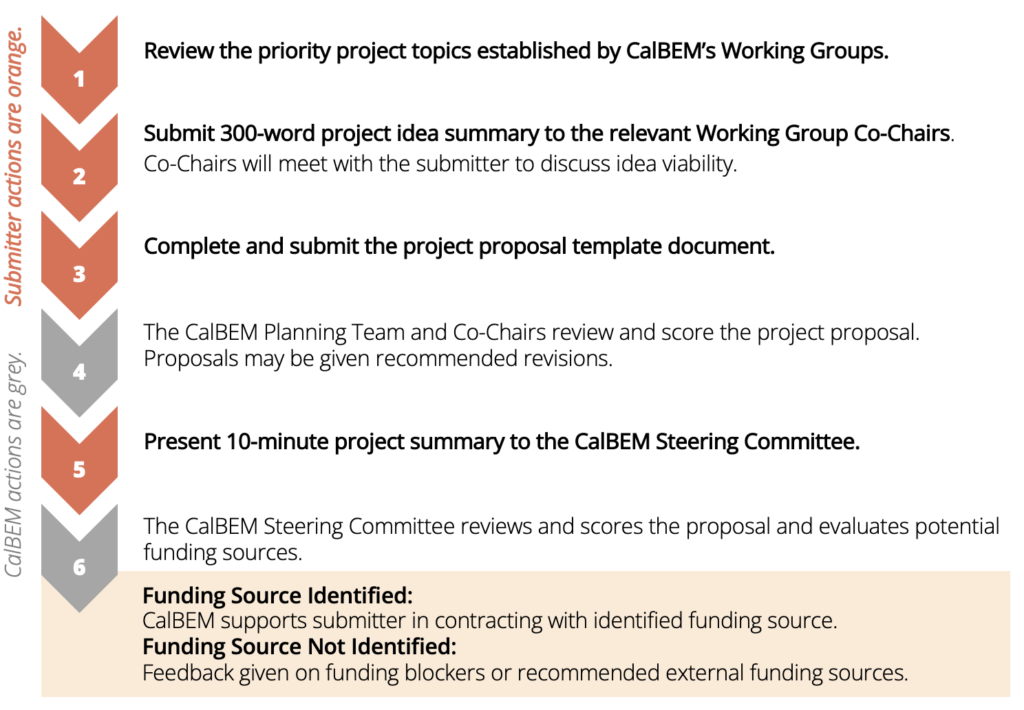
Step 1: Review the priority project topics established by CalBEM’s Working Groups. Participate in a CalBEM Working Group event, or the main CalBEM event in the fall. These discussions serve as a crucible for project ideas, where the Working Groups brainstorm and curate priorities to further building energy modeling in California. After the event, follow up with the Working Group Co-Chair to discuss if a project proposal on the topic is appropriate and to identify helpful collaborators. To be considered for funding, a project topic must be prioritized by the appropriate Working Group and the final proposal must respond to the feedback gathered during the Working Group discussions.
Step 2: Submit 300-word project idea summary to the relevant Working Group Co-Chairs. Submit a summary (maximum 300 words) to the Working Group Co-Chairs and meet with them to discuss the project. The Working Group Co-chairs will perform a priority and viability check. They will also send an email to or plan a meeting with the Working Group about the proposed project to solicit initial feedback that will be used to inform their decision regarding approval to move to the next step in the process.
Step 3: Complete and submit the project proposal template document. With Working Group Co-chair approval, individuals or teams from the Working Groups are encouraged to create project funding proposals for high priority projects that are not being undertaken elsewhere. If you are unsure of the ideal proposal size, propose a phased project with easy to digest pieces or a scalable project with elements that could be sized to fit a budget range. If a project is too large to fund in entirety, the smaller options will be considered separately. Project Funding Proposal Application Templates can be found here and submitted to info@calbem.com.
Step 4: The CalBEM Planning Team and Co-Chairs review and score the project proposal. Proposals may be given recommended revisions.
Step 5: Present 10-minute project summary to the CalBEM Steering Committee. Steering Committee meetings are held every other month. You will be invited to join the meeting to present your project and answer questions raised by the Steering Committee members.
Step 6: The CalBEM Steering Committee reviews and scores the proposal and evaluates potential funding sources. The result, along with the rating summary and any Steering Committee feedback and recommended next steps, is returned to the proposal team and may be reviewed by the relevant Working Group(s).
During the review process the proposal will receive points in the following categories:
- X/15 Aligns with CalBEM Goals to Solve a Current or Emerging Problem
- X/15 Addresses Feedback from Working Group (if applicable)
- X/10 The Absence of this Project would be a Detriment to BEM
- X/10 Proposed Methodology has Merit
- X/10 Organizations/Individuals Listed are Likely to Succeed
- X/5 Budget and Schedule are Reasonable
- X/5 Co-Funders have been Identified
Schedule
Table 1 presents a tentative rolling submittal and review schedule for 2026/2027. CalBEM Planning Committee and Steering Committee may adjust the schedule as needed to facilitate a process that supports prioritized projects being considered for funding.
Table 1. Tentative Schedule for 2026/2027 Rolling Funding Application Process.
| 4/2026 – 5/2026 | Spring Submission Period |
| 5/2026 | Planning Team Reviews Proposals for Relevance and Completion |
| 6/2026 | Proposal Review Session by CalBEM Steering Committee |
| 6/2026 – 7/2026 | Summer Submission Period |
| 7/2026 | Planning Team Reviews Proposals for Relevance and Completion |
| 8/2026 | Proposal Review Session by CalBEM Steering Committee |
| 11/2026 | CalBEM 2026 |
| 12/2026 – 3/2027 | Winter Submission Period |
| 3/2027 | Planning Team Reviews Proposals for Relevance and Completion |
| 4/2027 | Proposal Review Session by CalBEM Steering Committee |
Additional questions? Reach out to info@calbem.com.