CalBEM Prototypes Development Project
The objective of the California Prototypes Development project, funded by Southern California Edison’s (SCE) Codes and Standards Program, is to develop a set of prototype building models representing California’s residential and nonresidential building stock that can be used by policy-making agencies and other stakeholders. Prototypes developed under this project attempt to capture features of California’s building stock using the latest data sources. The models and model inputs development were developed with input from a technical advisory group (TAG) and underwent review from several parties during the development process. The models and the underlying model inputs and assumptions have been documented and can be accessed from this page.


Project Background
Currently, multiple sets of prototype models are being used by policy-making agencies to perform analyses in California. Government agencies, private entities, consultants, and other market actors use models that are accessible to them, resulting in a lack of uniformity in predicted outcomes and confusion about which models are appropriate for use. The CalBEM Prototypes project aims to change this current market state.
The Prototypes Project scope includes the development of prototype models for single-family, multifamily, and nonresidential building sectors. As part of this project, a Technical Advisory Group (TAG) was convened comprising the CEC, CPUC, SCE, NORESCO, Energy Solutions, and other interested parties, including DOE national laboratories and national experts. This TAG has guided the development of the prototype models. NORESCO leads the technical development of the prototype models and Energy Solutions has managed the project on behalf of SCE. The TAG meets on a bi-monthly basis and has been meeting since the beginning of 2021 to develop the project framework and guide model development.
For each of the three building sectors (single-family, multifamily, and nonresidential), the development of prototype models was divided into four major tasks:
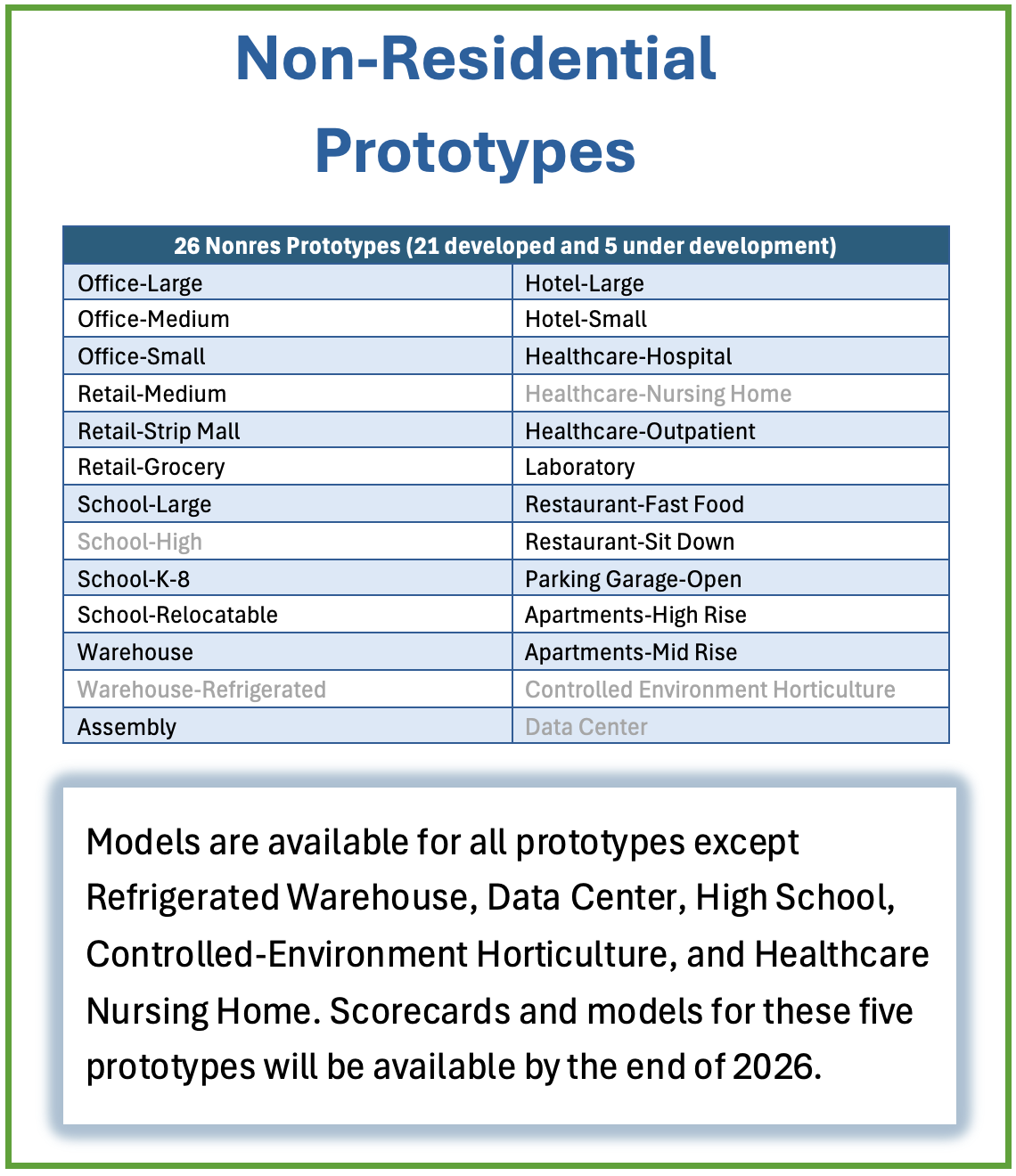
- Building stock assessment: To develop models that represent the California building stock, the characteristics of the buildings must be captured in the models. A building stock assessment was conducted using permits records and existing buildings data to establish this foundation. From this assessment, and considering the requirements of specific use cases, a mix of prototype models was selected to capture the key characteristics of buildings across the state.
- Model inputs development: For each selected prototype, key inputs were defined for envelope, lighting, HVAC, water heating, plug and process loads, and other systems. These inputs—including geometry, zones, and space types—were documented in individual spreadsheets, called ‘scorecards’.
- Model construction: Based on the inputs developed in the preceding step, models were constructed and expanded across climate zones and vintage bins using DOE’s EnergyPlus™ simulation engine and an internal parametric tool. For nonresidential models, an automated framework was developed to generate IDF files prototype scorecards. The models are publicly available for access and use, and feedback received on the models will be incorporated in the second version.
- Validation: Residential prototype models were validated at the end-use level using stock energy consumption data from the 2019 Residential Appliance Saturation Survey (RASS). Nonresidential prototype models were validated at the EUI level using data from the 2022 Commercial End-Use Survey (CEUS) and ENERGY STAR Portfolio Manager.
Model input documentation and the open nature of dialogue and collaboration between stakeholders via the Prototypes TAG are key features of this project. The intent is to rigorously document the assumptions, host the models and documentation on a public platform, and provide a forum for continuous improvement, maintenance, and development.